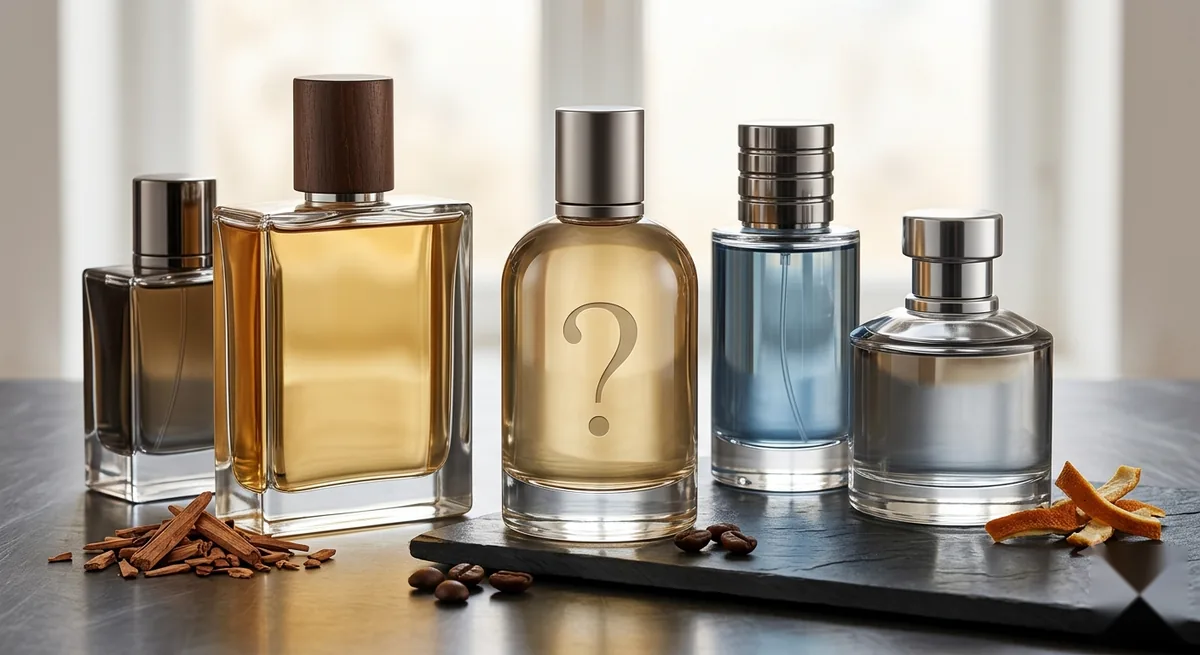
The science of picking a cologne
Choosing fragrance can feel like guesswork, but underneath the marketing there is a fairly small set of levers that decide whether a cologne works for you: which scent family it belongs to, how concentrated it is, how far it projects, how it evolves over the day, and — the part most guides skip — how it reacts with your own skin. Understand those five and you can predict, before you ever spray, whether a bottle is likely to suit you.
1. Scent families — the single biggest filter
Every fragrance sits inside a broad family, and your family preference is the fastest way to narrow thousands of bottles down to a handful. These are the ones that matter most for men’s luxury cologne:
- Fresh / Citrus — bright and energetic, built on bergamot, lemon and grapefruit. Reads clean and easy; ideal for daytime, office and warm weather. Think Acqua di Parma Colonia.
- Marine / Aquatic — salty, airy, ozonic, evoking sea breeze and clean water. The definition of effortless. Think Acqua di Giò.
- Aromatic / Fougère — the classic “barbershop” accord of lavender, sage and rosemary. Sharp, herbal and traditionally masculine. Think Bleu de Chanel.
- Woody / Earthy — grounded and refined, leaning on cedar, sandalwood, vetiver and oud (a rich, resinous wood extract). Reads rugged or seriously professional. Think Tom Ford Oud Wood.
- Amber / Spicy — warm and intimate, dominated by vanilla, cardamom, cinnamon and tonka bean. Best for evenings and cold weather. Think Sauvage Elixir.
- Gourmand — the rising trend: edible-adjacent notes like rum, chestnut, coffee and honey. Bold, sweet and memorable. Think Stronger With You Absolutely.
If you take nothing else from this page, take this: a fragrance you love and one you hate can share a price tag and a designer — the family is usually what separates them. Nail the family first.
2. Concentration & longevity
The letters on the box aren’t branding — they tell you how much fragrance oil is in the bottle, which largely dictates how long it lasts and how heavy it feels:
| Concentration | Fragrance oil | Typical wear | Feel |
|---|---|---|---|
| Eau de Toilette (EDT) | ~5–15% | 4–6 hours | Lighter, daytime |
| Eau de Parfum (EDP) | ~15–20% | 6–8+ hours | Rounded, versatile |
| Parfum / Elixir | ~20–40% | 10+ hours | Dense, heavy, potent |
Higher concentration doesn’t just mean “stronger” — it also shifts the character toward the deeper base notes and away from the bright opening. That’s why the Elixir or Parfum version of a fragrance you know can smell noticeably richer and less citrusy than the EDT. If longevity is your top complaint, moving up a concentration usually solves it faster than switching fragrances entirely.
3. Projection vs. sillage — how loud is loud?
Two different things get confused constantly. Projection is how far the scent radiates from your body right now; sillage is the trail it leaves behind as you move through a space. You want to match both to context:
- Intimate skin scent — stays within arm’s reach. Perfect for the office, close quarters and quiet luxury. Oud Wood lives here.
- Moderate bubble — fills your personal space and is noticed as you pass. The safest all-rounder. Bleu de Chanel lives here.
- Beast mode — fills the room and lingers after you leave. Reserve it for big events and cold-weather nights — it can overwhelm a meeting. Sauvage Elixir lives here.
The most common fragrance mistake isn’t buying the wrong scent — it’s buying the right scent at the wrong volume for where you’ll wear it.
4. The fragrance pyramid: why a cologne changes on you
A good fragrance isn’t one smell — it’s a sequence. Perfumers build it in three layers, and the reason they unfold in order comes down to simple physics: lighter molecules evaporate first, heavier ones last.
- Top notes (first ~5–20 minutes): the opening handshake — usually citrus, herbs or light spice. Bright, attention-grabbing and quick to fade. Never judge a bottle on this alone.
- Heart notes (~20 minutes to a few hours): the true personality of the scent, often florals, spices or fruit. This is what you’ll actually smell like most of the day.
- Base notes (hours, sometimes into the next day): the foundation — woods, amber, musk, vanilla, oud. These heavy molecules also act as fixatives, slowing the lighter notes and giving the fragrance its staying power.
The practical takeaway: give any cologne 30 to 60 minutes on your skin before you decide. The version that made you reach for your wallet at the counter is the top notes — the version you’ll live with is the dry-down.
5. Why the same cologne smells different on everyone
This is the part that trips buyers up most, and it’s worth understanding before you trust any online review of longevity. A fragrance’s performance is an interaction between the formula and your skin — not a fixed number printed on the box. The same Eau de Parfum can last ten hours on one person and three on another. Here’s what drives that:
- Skin oil. Oily skin gives fragrance molecules something to bind to, so scent lasts longer and projects more — especially richer woods, resins and musks. Dry skin lets fragrance evaporate faster, so top notes vanish quickly and the whole thing can drop off sharply.
- Skin pH. More acidic skin tends to flatter florals and sweeter accords; more alkaline skin can sharpen citrus. It’s subtle, but it’s why a note someone raves about can read differently on you.
- Body temperature. Warmer skin makes a fragrance bloom — stronger initial projection, but faster fade. Cooler skin holds it closer and slower.
- Climate. Heat and humidity speed evaporation (great for a big first impression, worse for all-day wear), which is why light citrus can disappear on a hot afternoon while amber and wood thrive in the cold.
The rule that follows from all of this: test on skin, not on a paper blotter, and not on someone else’s recommendation. Paper strips and reviews are unreliable predictors because they can’t account for your chemistry.
How to make any cologne last longer
If your fragrance keeps fading before lunch, technique matters as much as the bottle. What buyers and perfumers consistently recommend:
- Moisturize first. Apply an unscented lotion to pulse points before spraying — hydrated skin holds fragrance molecules far better than dry skin. This is the single biggest fix for dry skin.
- Hit the pulse points. Neck, behind the ears, inner wrists and inner elbows — warm areas that gently diffuse the scent all day.
- Don’t rub your wrists together. It sounds harmless but it fractures the top notes and can distort the trail. Spray and let it dry.
- Use fabric. A light spray on a scarf, collar or jacket lasts longer than skin alone — fabric fibers hold scent for hours (test on inconspicuous fabric first).
- Size up the concentration. If you love a scent but not its staying power, the EDP or Parfum version often solves it outright.
What buyers actually report
Because we build recommendations from aggregated buyer sentiment rather than a single reviewer’s nose, a few patterns show up again and again across the luxury cologne category — and they’re more useful than any note pyramid:
- “Compliment frequency” is the real currency. Buyers rarely describe notes in technical terms — they count compliments. Aventus and Sauvage Elixir dominate that language; Oud Wood earns quieter, closer-range praise by design.
- Longevity complaints cluster on lighter concentrations. The colognes buyers call “beautiful but gone by noon” are almost always classic Eau de Cologne or EDT — Colonia included. That’s expected, not a flaw; it’s the concentration talking.
- Versatility is prized over uniqueness for a first bottle. Bleu de Chanel and Aventus rank so highly partly because buyers can wear them anywhere. Save the polarizing, distinctive picks for a second or third bottle.
The nine scents in this quiz, at a glance
Want the full rankings?
The quiz is a shortcut. If you’d rather read the case for each bottle in depth — with buyer-sentiment breakdowns, pros and cons and value notes — start with our full ranking guides.
Read: Best Luxury Cologne for Men, Ranked by Buyers →