⚠
For informational purposes only. As an Amazon Associate, The Grooming Score earns from qualifying purchases. Rankings reflect aggregated buyer sentiment, not personal testing.
Ranking · Shaving
Best Luxury Safety Razors for a Close Shave
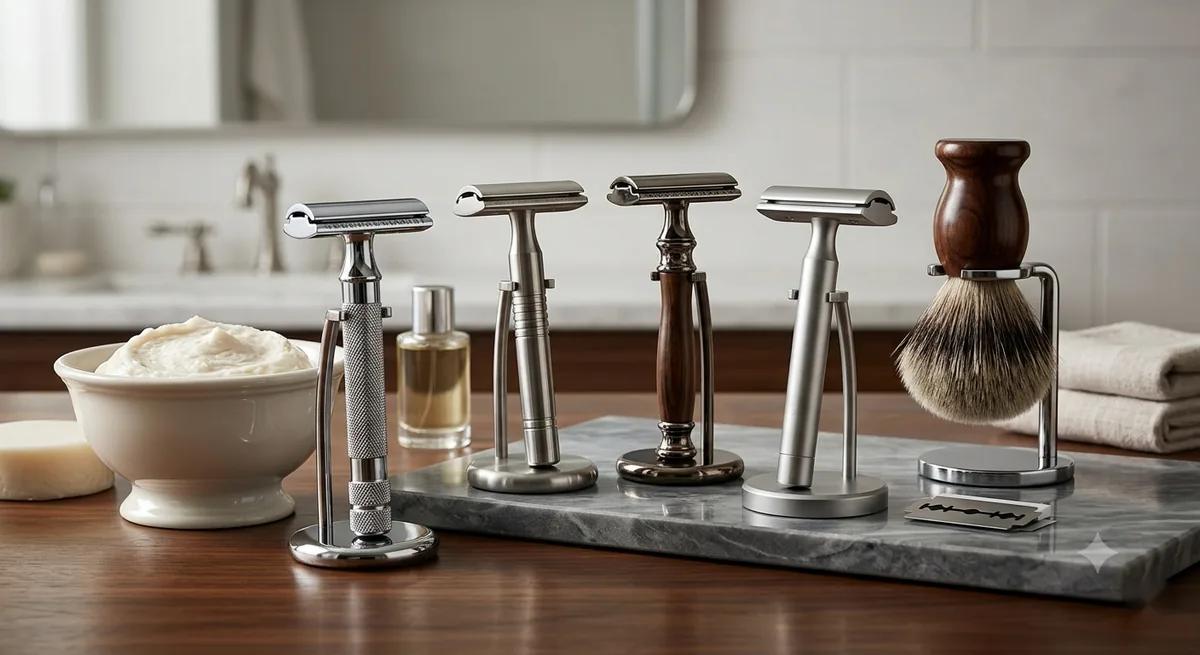
Eight premium double-edge razors, ranked by buyer sentiment — and mapped on the axis the spec sheets never show you: how much technique error each one forgives.
📅 Published: July 19, 2026
🔄 Updated: July 19, 2026 · How we rank →
🕐 Data pulled: July 19, 2026
12 min read
A safety razor is the rare grooming purchase that gets cheaper the longer you own it. The blades cost pennies, the tool itself can outlive you, and the shave — once your hand learns the angle — is closer than anything a five-blade cartridge will give you. The catch is that the razor you buy determines how brutal that learning period is, and almost nobody tells you that before you spend $120.
So that is what we built this ranking around. Every page competing for this term lists blade gaps in millimetres, which tells you precisely nothing about how a razor behaves in a tired hand on a Tuesday morning. We went through owner reports on the wet-shaving forums and Amazon listings instead, and mapped each razor on two axes buyers actually talk about: how close it shaves and how much technique error it forgives before it draws blood. Our overall pick is the Rockwell 6S, which sidesteps the whole problem by letting you dial aggression up as your skill improves. First-timers should look hard at the Henson AL13; anyone who just wants the classic that has worked for forty years should buy the Merkur 34C and stop reading.
The Shortlist
1
Best Overall
Rockwell 6S — six blade gaps, so it grows with your technique
5
Best Heirloom
Feather AS-D2 — Japanese tolerances, ultra-mild, buy the right blades
The razor that removes the guesswork. Six blade gaps across three reversible stainless plates mean buyers can start ultra-mild and climb as their technique improves — and owners routinely report running a more aggressive plate on the cheeks and a milder one on the neck, which no fixed razor allows. Sentiment holds or improves across the first year, and it rarely turns up on the secondary market except from people upgrading to the titanium version. The recurring complaint is quality control on the threads: multiple buyers report the top-cap thread arriving rough or stripping, though Rockwell’s support gets consistent credit for replacing them.
Six gaps in one razorSentiment improves over timeRugged bead-blasted 316LReported thread QC issuesChunky head under the nose
Best for: Anyone unsure how aggressive a razor they need — which is most first buyers
Aerospace machining applied to a shave. The head’s flat bevels physically hold the blade at the correct angle, and the blade is clamped so close to its cutting edge that buyers report chatter and skin-pinching essentially disappear — the two things that make a beginner’s first month miserable. Cartridge converts consistently say it feels familiar rather than foreign. The trade-off is the weight: at 37 g it does not shave under its own mass, so it asks for a little pressure, which is exactly the habit traditional wet-shavers have spent years unlearning.
Head enforces the correct angleNo blade chatter or pinchingSold direct by the brandToo light to shave under its own weight
Best for: Your first double-edge razor, or anyone converting from cartridges
The default recommendation of the wet-shaving world for decades, and still hard to argue with. Buyers praise the head-heavy balance that lets gravity do the cutting, and the knurled handle draws near-universal credit for staying grippy with soapy hands. Two caveats recur: the two-piece design makes the inside of the handle barrel awkward to clean, and the chrome-plated Zamak body is brittle — long-term owners report snapped top-cap posts after a single drop onto tile. Sentiment splits sharply on the short 76 mm handle: large hands feel cramped, everyone else says it improves control at the jawline.
Head-heavy, gravity does the workGrippy knurled handleCheap enough to travel withZamak threads snap if droppedShort handle cramps large hands
Best for: Traditional starters, travel kits, and anyone who wants one razor and no decisions
The best-finished razor at its price by a wide margin — buyers repeatedly describe the mirror chrome as looking like liquid sterling, which is why it is the default gift razor. It shares its head design lineage with Mühle’s classic, and the geometry keeps it mild while still shaving cleanly. The complaint owners raise most is the handle: the smooth-handled variants get slippery under lather and get dropped, which for a Zamak razor is not a trivial risk. Sentiment splits on mildness — thick necks report needing extra passes, while sensitive skin reports never getting burn.
Best finish at this priceForgiving mild geometryStable authorised distributionSmooth handle gets slippery under lather
Best for: Gift buyers, normal skin, daily shavers who want mild and pretty
Mühle’s design language in CNC-machined stainless rather than plated Zamak, and the efficiency is what owners talk about. Buyers with dense, coarse growth report it clearing a full pass without pulling or clogging, and the satin finish gets compared to high-end watch cases. It is also the least forgiving fixed razor here: reviewers are consistent that it demands a light touch, and some reserve it for every-other-day shaving rather than daily use. Early production had top-plate alignment and thread durability problems; the design has been revised, but buyers still occasionally report old stock arriving from third-party sellers.
Clears coarse growth in one passMachined 316 stainlessGenuinely premium finishPunishes a distracted handOld stock still circulating from resellers
Best for: Experienced hands with coarse, dense beards
Made in Seki to tolerances nobody else on this list attempts, and the most polarising razor here. Owners describe blade alignment as perfect every time with zero play, and those with sensitive skin call it the most comfortable shave of their lives. Those with thick, coarse hair call it inefficient and report needing three or four passes — frustrating at this price. The split is almost entirely explained by blades: paired with Feather Hi-Stainless it works; paired with anything milder, buyers conclude it does not cut hair and resell it inside ninety days. Note the sourcing caveat below before buying.
Flawless engineering tolerancesIrritation-free on sensitive skinGenuinely heirloom-gradeInefficient on coarse hairVery narrow sweet-spot angle
Best for: Sensitive skin, light-to-medium growth, and shavers who already have their technique
⚠Sourcing note: a meaningful share of AS-D2 units on Amazon US are grey-market imports. The razor is generally authentic, but buyers report Japanese-market packaging with no English documentation and no US warranty support. Buy from a listing that ships from Amazon, check the seller rating, and expect the box to be the compromise — not the tool.
A solid-brass adjustable at half the price of the stainless competition, and the weight is the selling point — at 110 g owners say the razor does all the cutting and the hand just steers. The dial clicks firmly into place and the textured handle gets consistent credit for grip. The recurring complaint is alignment: buyers across forums report the top cap seating slightly asymmetrically during blade loading, leaving one side shaving more aggressively than the other. Sentiment splits on the mass itself, which reads as commanding to some and fatiguing across a three-pass shave to others.
Heavy brass does the cuttingFirm, precise adjustment dialAdjustable at a fixed-razor priceBlade alignment asymmetry reported
Best for: Heavy beards that want an adjustable without stainless-steel money
A specialist tool that beginners keep buying by accident. Owners with very coarse hair report it mowing down a week of growth in a single pass without resistance, and head-shavers rate it highly. But even setting 1 is reportedly more aggressive than a fully cranked DE89, and above setting 3 owner threads call it a paint scraper. Two practical warnings recur: the snap-on top cap makes blade changes genuinely hazardous with wet hands, and the boxy head cannot get cleanly under the nostrils. It also has the highest resale churn on this list — enthusiasm rarely survives ninety days.
Unmatched efficiency on coarse hairStrong for head-shavingDistinctive Bauhaus designSnap-on cap makes blade changes riskyCannot navigate under the noseHigh resale churn
Best for: Advanced shavers, head shavers, and genuinely wire-like growth
⚠Sourcing note: cheap clones copy the Futur’s look without the internal spring tension that makes the adjustment mechanism work. Confirm the listing is an authorised Merkur distributor rather than a lookalike listing at a suspicious price.
The Aggressiveness-vs-Forgiveness Matrix
Blade gap is a specification. Forgiveness is an experience. A razor with a wide gap and a rigid, tightly clamped blade can be gentler than one with a narrow gap and lots of exposure — which is why spec sheets mislead beginners so badly. Below, both axes are scored 1–10 from aggregated owner reports: closeness is how few passes buyers need to get smooth, and forgiveness is how much bad angle and heavy pressure the razor tolerates before it bites.
The two mild outliers that still shave close
The Feather AS-D2 and the Henson AL13 land in the same top-right corner of the matrix from opposite directions. Owners on Badger & Blade describe the Feather as so gentle it barely registers on the face — one recurring line is that it feels more like a squeegee than a blade — and yet with a sharp enough blade it still clears stubble without leaving irritation behind. The Henson gets there by engineering rather than geometry: buyers report the flat bevels on the head physically force the correct angle, and the blade is clamped so close to its edge that chatter and skin-pinching essentially stop being possible. Different philosophies, same result for the user — a shave that is hard to get wrong.
The two that punish you
At the other end, the Mühle Rocca and the Merkur Futur trade forgiveness for speed. Owners with dense growth say the Rocca clears a full pass without pulling or clogging, but reviewers are consistent that it demands a light touch and rewards a distracted one with weepers. The Futur is the extreme case: on the higher settings it is widely described in owner threads as a paint scraper, and even long-time wet-shavers report needing full concentration to use it. Neither is a bad razor. Both are bad first razors.
Why adjustables score twice
The Rockwell 6S, Parker Variant and Merkur Futur get ranges rather than points because they move along the diagonal. That is the entire argument for buying one: instead of guessing which fixed razor matches a face you have not learned to shave yet, you start mild and climb. Owners of the 6S routinely describe running an aggressive plate on the cheeks and swapping to a milder one for the neck — a level of control no fixed razor at any price offers.
What Happens After the Honeymoon
Buyer sentiment at 30 days and buyer sentiment at a year are not the same data. Reading the buy/sell/trade threads alongside the reviews shows a clear split between razors that hold their owners and razors that quietly end up in a drawer.
Sentiment that holds or improves
The Rockwell 6S is the strongest performer here. Buyers report immediate relief from razor burn because they can start on a low plate, and sentiment climbs over the first year as they graduate upward — the razor grows with them rather than being outgrown. It rarely appears on the secondary market except from owners upgrading to the titanium version of the same design, which is about as good a signal as this category produces. The Henson AL13 follows a similar arc for practical buyers, though some hobbyists report eventually selling it out of boredom, wanting more blade feel than it is designed to give.
Sentiment that sours
The Merkur Futur has a notably high churn rate in owner-resale threads. Buyers are drawn in by the industrial design and the sheer efficiency, then report two things within about ninety days: the head is too bulky to work under the nose, and the aggression on higher settings stops being fun. The Feather AS-D2 fails differently and more expensively. Buyers pair the mildest razor on this list with mild blades, conclude it does not cut hair, and resell it — when the fix is simply a sharper blade. Owners who make that switch inside the first three months tend to keep it permanently.
The pattern worth knowing
The razors that get resold are not the bad ones. They are the ones bought without a plan for the learning curve — the aggressive tool bought by a beginner, and the ultra-mild tool bought without the blade that makes it work. Match the razor to the shave you can currently execute, not the one you aspire to.
Specs at a Glance
Buyer-reported and manufacturer specs compiled July 19, 2026 — verify current listings before purchasing.
What to Buy Alongside It
The razor is the smallest part of the shave. Three things matter more than which model you picked, and owners are unusually unanimous about all three.
Buy a blade sampler, not a hundred blades
The single most repeated piece of advice in wet-shaving communities: never buy a bulk pack of one blade with a new razor. Blades and razor geometries interact — the blade that feels glassy in a mild Edwin Jagger can feel like sandpaper in a Mühle Rocca. A double-edge blade sampler pack typically bundles five-blade tucks of Astra Superior Platinum, Feather Hi-Stainless, Derby, Gillette Silver Blue and a few others, which is enough to find your combination for the price of a couple of cartridges. Owners generally settle on Astra or Gillette Silver Blue as smooth all-rounders, and reserve Feather for razors that need help — which, on this list, means the AS-D2.
The cream matters more than the razor
A safety razor needs a slick, cushioning lather in a way a cartridge does not. Owners of the daily-driver razors here overwhelmingly reach for Proraso Green for its cooling bite and easy lather, though some note it lacks the heavy slickness an aggressive razor wants. Henson owners like Jack Black Beard Lube specifically because it is translucent — you can see exactly where that unusual head is going. For the Feather and the Rocca, the recurring luxury pairing is Art of Shaving Sandalwood cream, praised for a dense, glycerin-rich cushion on sensitive skin. All three are covered in more depth in our luxury shaving and beard ranking.
Post-shave, and the honest feedback tool
Experienced owners describe an alum block as the truth teller: rub it over a wet face and it stings exactly where your technique was poor, which is the fastest feedback loop available for shortening the learning curve. Follow with an alcohol-free balm rather than a traditional splash if your skin is at all reactive — our post-shave repair ranking covers what buyers report actually settles razor burn.
Frequently Asked Questions
How many passes do you actually need for a clean shave?
Experienced owners converge on three: with the grain to remove bulk, across the grain to clean up, and against the grain for a final smooth finish. Beginners are widely advised to stick to the first two passes for the first few weeks — the against-the-grain pass is where most early irritation comes from.
Do safety razors actually save money compared to cartridges?
Yes, provided you buy one razor rather than five. Double-edge blades run roughly $0.10–$0.25 each against $4–$6 for a cartridge, so even a $120 razor typically breaks even inside the first year. The failure mode owners joke about is collecting razors, which cancels the savings entirely.
Can you bring a safety razor on a plane?
The handle can go in a carry-on; the blades cannot. If you are travelling carry-on only you will need to buy blades at your destination or ship them ahead. This is a large part of why a cheap, robust two-piece like the Merkur 34C is the razor owners recommend putting in a dopp kit.
How long is the learning curve coming from a cartridge?
Most buyers report feeling comfortable with the weight and angle somewhere around the tenth to fifteenth shave, with cuts and irritation dropping off sharply by about the thirtieth as muscle memory sets in. Starting on a forgiving razor compresses that considerably — which is the whole argument for the Henson or a low Rockwell plate.
What is the real difference between stainless steel and chrome-plated Zamak?
Zamak is cast zinc alloy with chrome plating over it — affordable and perfectly good to shave with, but brittle. Owners report threads snapping after a single drop onto tile, and if the plating chips the zinc underneath corrodes. Machined stainless costs two to three times more and is effectively indestructible. Both shave well; only one survives being knocked off a sink.
Which blades should you start with?
A sampler pack rather than a commitment. Blade preference is highly individual and interacts with the razor’s geometry, so the blade that suits a mild razor may feel rough in an aggressive one. Astra Superior Platinum and Gillette Silver Blue are the common smooth starting points; Feather blades are sharp and are usually reserved for razors mild enough to need the help.
📅Data note: Prices and buyer sentiment reflect Amazon.com data compiled July 19, 2026 and change continuously. Many listings are third-party — confirm the seller and current price before purchasing.
Related Rankings